Asking about Japanese

JLPT N52 sets · 12 lines

Six sentences for class: asking someone to slow down and asking how to read a word and what it means. Then, after class, you ask your teacher how to remember katakana words.

What this page practisesasking someone to speak more slowly with もう少しゆっくり話してください · asking how to read something with どう読みますか · asking what something is called in Japanese with 日本語で何ですか · saying you don't know what a word means with 意味が分かりません (with が) · asking permission with 〜てもいいですか · raising a question with 質問があります · asking for help with ちょっと教えてください · asking how to do something with どうやって · suggesting doing something together with 〜ましょう

Six ways to ask about Japanese

Single lines · 6 lines

When you don't understand or don't know how to say something, these sentences keep the conversation going.

  1. すみません、もう少すこしゆっくり話はなしてください。

    Excuse me, could you speak a little more slowly?

  2. この漢字かんじはどう読よみますか。

    How do you read this kanji?

  3. これは日本語にほんごで何なんですか。

    What is this called in Japanese?

    The simplest way to ask what something is called in Japanese is 日本語で何ですか.

  4. この言葉ことばの意味いみが分わかりません。

    I don't understand what this word means.

    When saying whether you understand something, 分かります usually takes が: 意味が分かりません.

  5. 英語えいごで話はなしてもいいですか。

    May I speak in English?

  6. 先生せんせい、質問しつもんがあります。

    Sensei, I have a question.

Asking the teacher after class

Dialogue · 6 lines

You can't remember katakana loanwords, so you ask your teacher after class how to learn them. The teacher mentions a katakana test next week.

  1. me

    ちょっと教おしえてください。カタカナの言葉ことばが難むずかしいです。

    Could you help me with something? Katakana words are hard for me.

    Many Chinese speakers already know the shapes of kanji, so katakana loanwords like テーブル and エレベーター can actually be harder to remember.

  2. teacher

    そうですね。毎日まいにち少すこし練習れんしゅうしましょう。

    I see. Let's practice a little every day.

  3. me

    どうやって覚おぼえますか。

    How should I memorize them?

    どうやって asks how to do something.

  4. teacher

    声こえを出だして読よんでください。ノートに書かくのもいいですよ。

    Read them out loud. Writing them in your notebook is good, too.

  5. me

    わかりました。毎朝まいあさ読よみます。

    Got it. I'll read them every morning.

  6. teacher

    来週らいしゅう、カタカナのテストをしますよ。

    We'll have a katakana test next week.

Audio on this page is AI-synthesized speech (Gemini 3.1 Flash TTS), not a human recording; the sentences are original.


Say it right, write it right

Core lookup works fully offline, with cloud pronunciation and one-tap save & review. Free, no sign-up.

Free downloadWindowsFree downloadmacOSDownload on the App StoreGet it on Google Play
MobileiOS / Android

Android

QR code for the Google Play pageGet it on Google Play

Scan it with your Android phone to install, or search for “Tomoshi” on Google Play.

iOS

QR code for the App Store pageDownload on the App Store

Scan it with your iPhone camera to install, or search for “Tomoshi” in the App Store.

Install the browser extensionLook words up on any web page · Chrome / Edge / Safari

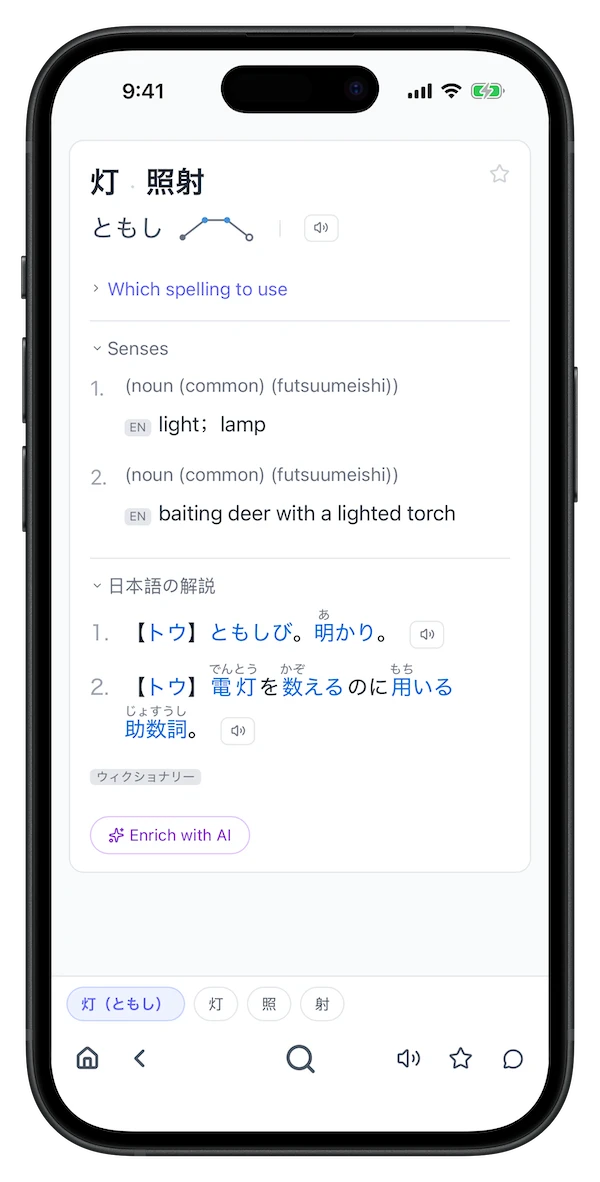
Screenshot of a Tomoshi lookup resultScreenshot of Tomoshi lookup results on a phone

Windows macOS Chrome / Edge / Safari extension iOS / Android